 Oleon
OleonCRM for e-commerce
Sell in the chat.
Answer it there too.
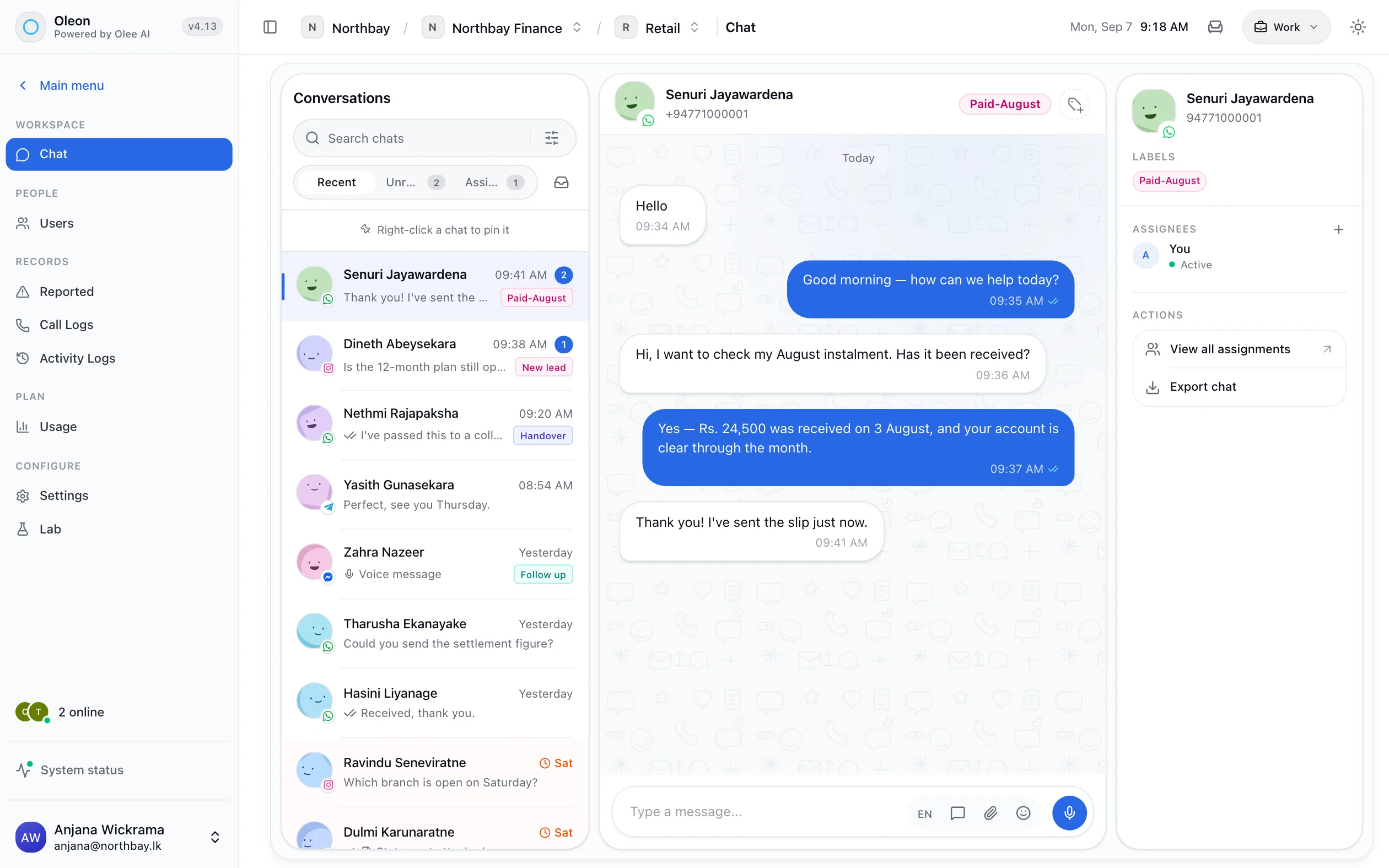
Products, carts, orders, delivery addresses, cash-on-delivery confirmation and “where is my order” run on their own, on WhatsApp and Instagram. Your team gets the conversations that decide whether a customer comes back.


Automation
What runs on its own.
Most of a store's inbox is the same eight jobs.
Where is my order. Looked up in your store or courier system mid-chat, and answered with what it finds.
Sizes, delivery and returns. Answered from the knowledge base you wrote, word for word your policy.
Products in the chat. One product, a list, a carousel or the whole catalog, sent by the bot.
Cart to order. The customer's cart becomes a real order in Orders, marked as placed by Scout.
The delivery address. A shipping form inside WhatsApp fills in that order's address. No typing it out.
Cash on delivery, confirmed. A template before dispatch, and the customer's reply on the order's conversation.
The next sale. New arrivals or an abandoned cart, as a template to customers who opted in.
A person for returns. Damaged, wrong size, about to cancel. Assigned, and the bot stays quiet.
Cash on delivery
Confirm it, then pack it.
Before the parcel leaves, not after it comes back.
Cash on delivery has to be confirmed.
For a large share of orders here, the conversation before dispatch is the difference between a delivery and a returned parcel. It is a template send and a reply, and it belongs in the same inbox as everything else.
Every reply on its order's conversation.
Sent by your store through the API, the moment an order is ready. The answer comes back to the thread the customer bought in, where the packer can see it.
One order
From “price?” to the next sale.
Ten steps. One needs a person.
“Price?”
A customer sees your post and asks on Instagram, or taps the product's Message button on WhatsApp. Either way it lands in one inbox, and the agent answers from your knowledge base.
AI agentThe answer, on the customer's one record, marked as the agent'sThe product, in the chat
Scout sends the collection as a carousel from your WhatsApp catalog. The customer browses, picks a colour, and adds to the cart without leaving the chat.
ScoutThe products sent, in the threadThe cart becomes an order
When the cart arrives, a flow started by the order thanks the customer with the total and the item count, and the order is in Orders, marked as placed by Scout.
ScoutThe order, its items and who placed itThe address, on one screen
Scout sends the shipping address form for that order. The answers fill in the order's delivery address, exactly as if someone had sent the form from Orders.
ScoutThe address on the orderInto your store
If your stock and invoices live in another system, Scout posts the order to it with a web request as it happens.
ScoutYour systemThe request in the flow's runCash on delivery, confirmed
Before the parcel is packed, your system sends the COD confirmation template through the API. The customer's tap comes back to the same conversation, and nobody packs a parcel that will be refused.
Your systemThe template, its delivery state and the replyDispatched
When the courier collects it, your system sends the tracking template, from the same number the customer bought on.
Your systemThe template and its delivery state“Where is my order?”
Asked the next morning, and again in the afternoon. Scout looks the order up in your system and answers with its real state, not a promise to check.
ScoutYour systemEach lookup and the answer it producedWrong size, damaged, about to cancel
The conversation that decides whether you keep the customer. It is requested for a person, and the bot stays silent until they close it.
A personThe assignment, the assignee and every replyThe next sale
New arrivals to the customers labelled with what they bought, or a reminder to the ones who left a cart. Replies land in the inbox as ordinary conversations.
ReachDelivery per message, replies in the thread
Channels
One customer, whichever app.
They found you on Instagram. They bought on WhatsApp.
One record, both conversations.
The Instagram DM and the WhatsApp order hang off the same contact once they are identified, with the labels and the history following the person rather than the app. So the agent who takes the return sees the question that started the sale, and the next campaign knows what they bought.
Order status
“Where is my order?”
Answered, not promised.
The agent fetches the answer mid-conversation rather than reading from a script, so the customer gets the state of their order rather than a promise to check.
Where to use it
Four kinds of shop.
Each one a flow you can build in an afternoon.
- Starts with
- “Do you have this in M?” on a post or a reel
- Runs on its own
- Size guides, the carousel, cart to order, the address form, COD confirmation
- Comes to a person
- Exchanges, custom orders and anything about fit
- Starts with
- A question about a model, a warranty or a price
- Runs on its own
- Specs and warranty terms from the knowledge base, order status, dispatch updates
- Comes to a person
- High-value orders, faults and warranty claims
- Starts with
- A repeat customer sending the usual list
- Runs on its own
- The catalog in the chat, the cart, the address, delivery updates
- Comes to a person
- Substitutions and anything out of stock
- Starts with
- “Price?” in the DMs, forty times a day
- Runs on its own
- Prices and delivery answers, the move to WhatsApp for the order, payment slip approval
- Comes to a person
- The one-off requests that make the shop personal
Controls
The shop's rules, not the bot's.
Set once, kept on every order.
Your policy, word for word
The agent answers from your knowledge base. The returns policy it quotes is the one you wrote.
Your limits, as conditions
An order total above your COD limit, or a product you hand-make, routes to a person.
Payment slips checked by a person
For bank transfers, the bot waits until someone applies Paid, then carries on.
Roles for the team
Packers, customer care and the owner see what their role allows, and every channel has an owner.
Tested before it is live
Bot Studio warns about a product that is not published or a cart that is switched off, before a customer finds it.
Every version is kept
Each publish is a version you can see and go back to, so a sale-week change is easy to undo.
Getting started
Switch it on in this order.
The first step empties half the DMs.
Write the answers
Delivery charges, areas, sizes and the returns policy, in the knowledge base. That is most of the DMs.
Connect order status
Give Scout one endpoint that knows where an order is. It is the question asked most.
Confirm cash on delivery
Get the COD template approved and send it from your system before dispatch. Returns fall first.
Sell in the chat
Products, the cart, the order and the address as one flow. The sale never leaves WhatsApp.
Tech specs
Every one of these is a screen in the product.
- Products, carts and orders
- Triggers on orders and forms
- WhatsApp Forms
- Lookups to your own system
- Looks things up mid-chat
- Send from your own system
- Templated sends
- Segment a list
- Delivery reported per message
- Replies land in the inbox
- One inbox, every channel
Questions
Before you ask.
The ones we hear most about CRM for e-commerce. If yours is not here, the answer is a message away.
Can customers order inside WhatsApp?
Yes. A Scout flow sends products from your WhatsApp catalog as one product, a list or a carousel. The customer's cart becomes an order in Orders, and the shipping address form fills in that order's delivery address.
Can it connect to our store?
The agent can look things up mid-conversation, and MCP lets an AI client reach the workspace through the same controllers a person's request goes through, so access rules are inherited rather than reimplemented.
Can we recover abandoned carts on WhatsApp?
Yes, as an approved template to customers who opted in. Replies come back into the shared inbox.
Do Instagram DMs and WhatsApp show the same customer?
Yes, once identified. History and labels hang off the contact rather than the channel.
Keep exploring.
More of what Oleon does.
All industriesIt starts with one conversation.
Bring the channels you already answer on into one place, and see what the rest of the week looks like.
Not ready to sign up? Join the waitlist and we will come to you.