 Oleon
OleonCRM for healthcare
The front desk, automated.
The clinical, left to clinicians.
Doctors’ schedules, channelling, reminders, report-ready notices and the same fifty front-desk questions run on their own, on WhatsApp. Anything that sounds like medicine goes to a person, every time.
Automation
What runs on its own.
A front desk's day is the same eight jobs.
Hours, fees and directions. Clinic days, doctors' fees, parking, fasting before a test. From the knowledge base you wrote.
Channel a doctor. Specialty, doctor and a free number, looked up in your channelling system and booked there.
New patient details. Name, age, NIC and contact on one WhatsApp Form, before the patient reaches the counter.
Appointment reminders. An approved template the day before. A reply to reschedule lands in the inbox.
Is my report ready. Looked up in your lab system, and answered with its real state.
Prescription refills. A photo of the prescription arrives on the thread and goes to the pharmacy team.
The review, not forgotten. Patients due a follow-up get a template, by label, when they are due.
Clinical questions. Always to a person. The bot hands over and stays quiet until they close it.
The boundary
Very good at the administrative half.
And never caught answering the clinical half.
Answered by the agent
- “Which days does the cardiologist see patients?”
- “Do I need to fast before a blood sugar test?”
- “How much is the channelling fee?”
- “Is there parking at the hospital?”
Always handed to a person
- “Should I stop my blood pressure tablets?”
- “Is this rash something to worry about?”
- “What does this result on my report mean?”
- “Can I take this with my other medicine?”
The agent is scoped to what you gave it.
It answers from your knowledge base and hands over when a question falls outside it. Opening hours, locations, preparation instructions and booking are inside; anything resembling diagnosis is a handover.
One patient
From “when is the clinic?” to the three-month review.
Ten steps. Two need a person, and both are meant to.
The first question
A patient asks which days the cardiologist sees patients and what it costs. The agent answers from your knowledge base, in Sinhala, Tamil or English.
AI agentThe answer, in the thread, marked as the agent'sChannelling, in the chat
Scout offers the specialties and the doctors as a list, looks up the free numbers in your channelling system, and books the one the patient taps.
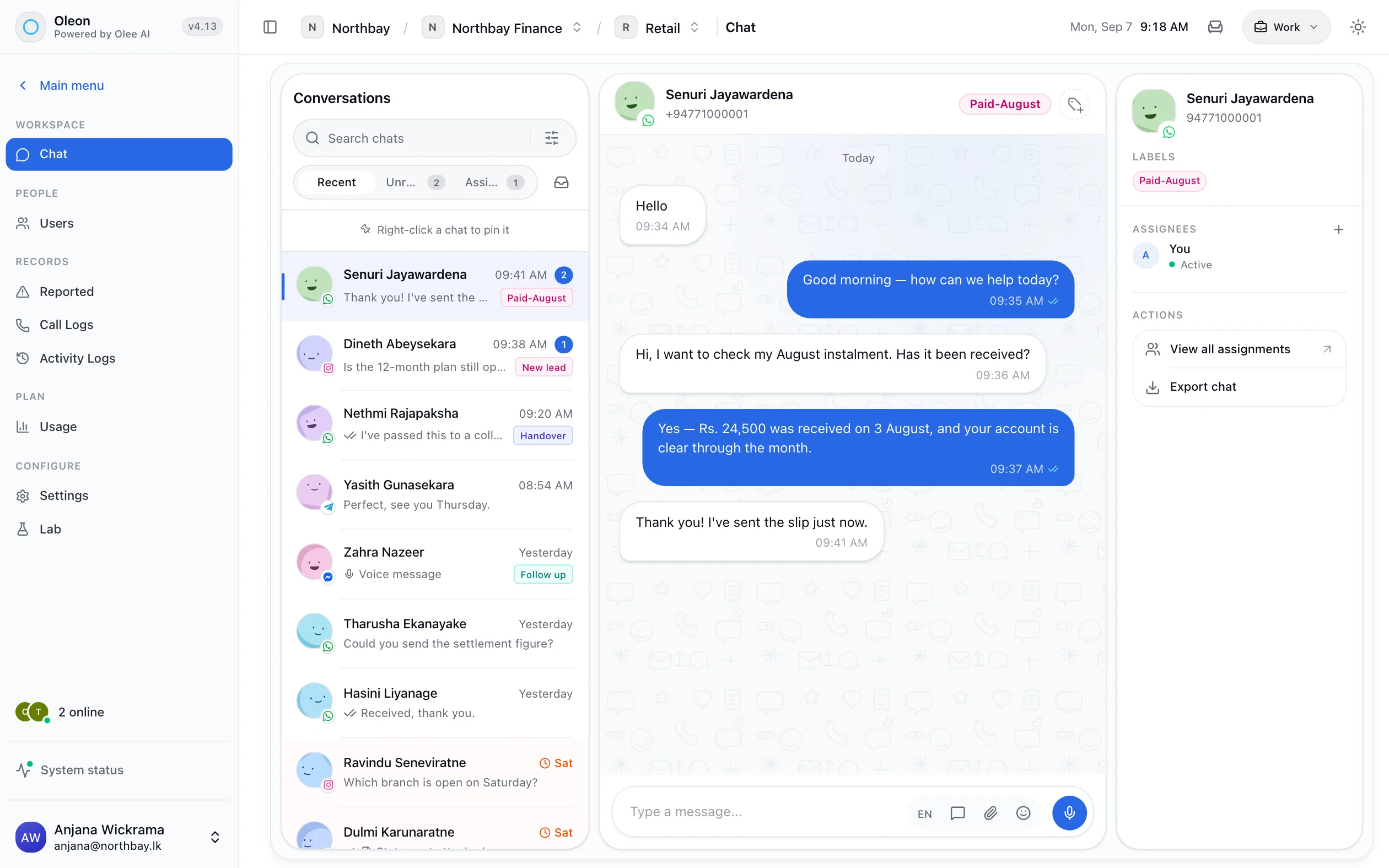
ScoutYour systemThe lookup, the booking request and the appointment numberFirst visit details
A new patient fills in a WhatsApp Form with their name, age, NIC and contact. The counter has them before the patient arrives.
ScoutThe submission, kept with the conversationThe day before
Your system sends the reminder template through the API: the doctor, the time, the number. The patient replies to it in the same thread.
Your systemThe template and its delivery stateReschedule, not no-show
“I can't come tomorrow.” Scout looks up the next free numbers and moves the booking, so the slot goes to someone else rather than sitting empty.
ScoutYour systemThe change, with both timesWhich number is in?
On the day, if your system tracks the queue, Scout answers with the number the doctor is seeing now. Fewer people standing at the counter asking.
ScoutYour systemEach lookup and the answer it producedThe report is ready
When the lab signs off a report, your system sends the patient a template to say it is ready to collect. “Is my report ready?” is answered before it is asked.
Your systemThe template and its delivery stateA refill
The patient photographs the prescription. It arrives on the thread and is requested for the pharmacy team, who check it and reply.
A personThe image, the assignee and every replyA clinical question
“Should I stop my tablets before the test?” The agent does not answer it. It is requested for a nurse, and the bot stays silent until the nurse closes it.
A personThe handover, the clinician and every replyThe review in three months
Patients labelled as due a review get the follow-up template when the time comes. A reply starts the channelling again.
ReachDelivery per message, replies in the thread
Reminders
Fewer calls.
Not the care.
Reminders reduce the calls, not the care.
Appointment reminders as approved templates, with replies returning to the inbox so a reschedule is a conversation rather than a phone queue.
Every answer on the patient's thread.
A “change time” is a conversation, not a missed appointment. Scout can offer new numbers, or reception can pick it up.
Access
Access is scoped, not shared.
Organisations, projects and roles decide who can open a conversation. A receptionist's inbox and a clinical team's are not the same inbox by default.
Where to use it
Four kinds of provider.
Each one a flow you can build in an afternoon.
- Starts with
- “When is Dr. Perera's clinic?”
- Runs on its own
- Doctor schedules, channelling through your system, reminders, the queue number on the day
- Comes to a person
- Admissions, billing disputes and anything clinical
- Starts with
- A parent asking if the doctor is in today
- Runs on its own
- Opening hours, bookings, new patient forms, the review reminder
- Comes to a person
- Symptoms, results and every medical question
- Starts with
- “Do I need to fast for this test?”
- Runs on its own
- Test preparation from the knowledge base, home-visit requests, report-ready notices
- Comes to a person
- Interpreting a result, which is a clinician's job
- Starts with
- A photograph of a prescription
- Runs on its own
- Opening hours, delivery areas, the prescription to the right branch's team
- Comes to a person
- Checking the prescription, substitutions and dosage
Controls
The clinic’s rules, not the bot’s.
Set once, kept on every conversation.
Clinical material stays out
The agent only answers from your knowledge base. Keep clinical content out of it and clinical questions reach a person.
Emergencies, answered first
Write your emergency instructions into the knowledge base, so “chest pain” gets the number to call, not a menu.
Reception and clinicians, apart
Roles and assignment keep booking conversations with reception and clinical ones with the clinical team.
One project per site
Each hospital, branch or pharmacy has its own inbox, its own numbers and its own team.
Every number has an owner
Channel ownership decides who answers the channelling line and who answers the pharmacy line.
Tested before it is live
A test panel and a problems list in Bot Studio, and every published version kept.
Getting started
Switch it on in this order.
The first step empties the phone queue.
Write the front-desk answers
Doctors' days, fees, directions and test preparation, in the knowledge base. Nothing clinical.
Connect channelling
One lookup for free numbers and one to book. Most of the phone queue goes with it.
Send the reminders
Get the reminder template approved and send it from your system the day before.
Reports and refills
Report-ready notices from your lab system, and prescriptions routed to the pharmacy team.
Tech specs
Every one of these is a screen in the product.
- Grounded answers
- Hands over to a person
- Menus, questions and conditions
- Lookups to your own system
- WhatsApp Forms
- Send from your own system
- Roles and access
- Templated sends
- Labels, with an owner
- Activity logs
- Sinhala, Tamil and English
Questions
Before you ask.
The ones we hear most about CRM for healthcare. If yours is not here, the answer is a message away.
Can patients channel a doctor over WhatsApp?
Yes, through your own channelling system. A Scout flow offers the specialties and doctors, looks up the free numbers in your system, and books the one the patient picks. Reminders go out as approved templates the day before.
Will the AI agent give medical advice?
It answers from the knowledge base you fill in and hands over when a question falls outside it. Keep clinical material out of the knowledge base and clinical questions reach a person.
Who can read patient conversations?
Access is scoped by organisation, project and role. Channels also have explicit owners.
Can we send appointment reminders?
Yes, as approved WhatsApp templates to patients who opted in.
Keep exploring.
More of what Oleon does.
All industriesIt starts with one conversation.
Bring the channels you already answer on into one place, and see what the rest of the week looks like.
Not ready to sign up? Join the waitlist and we will come to you.