 Oleon
OleonFeature
How to spend less on WhatsApp messages, and reach more customers
Meta now charges for everyday replies past 1,000 a month, and for templates even inside the 24-hour window. When you send, what you send and who you send it to decide what you pay.
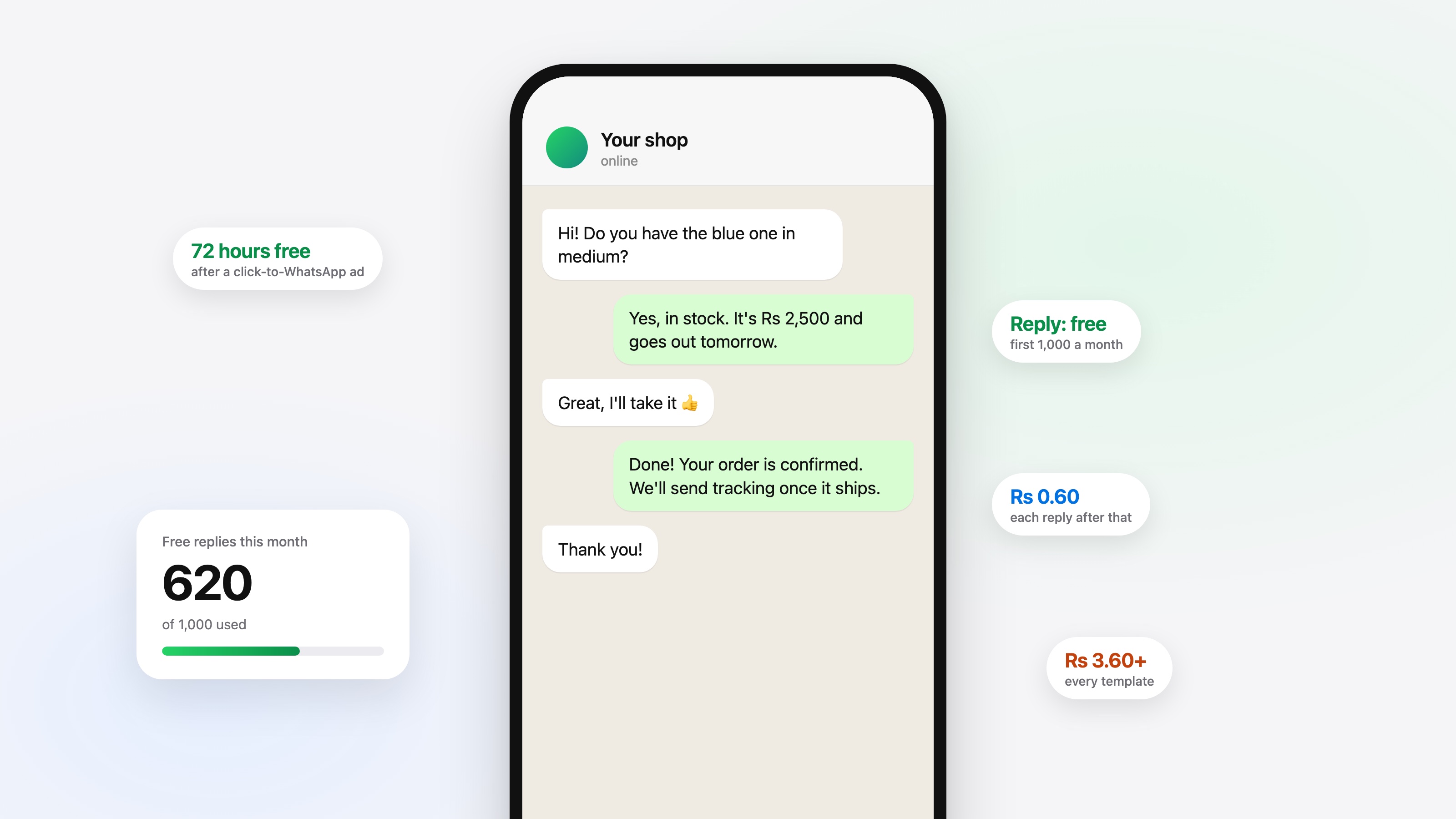
Since 1 October, Meta charges for the ordinary replies a business sends on WhatsApp once a number passes 1,000 in a month. Most businesses can keep their bill close to what it was, and reach more of their customers at the same time. It comes down to when you send, what you send, and who you send it to.
1,000
free replies a month, on each number
Rs 0.60
a reply after that, in Sri Lanka
Rs 3.60+
for every template, even inside the window
72 hours
of free messages after an ad
What does Meta charge for now?
Meta charges for each message that is delivered, by what kind of message it is and the country of the person receiving it. A message that never arrives costs nothing. There are four kinds:
- Marketing templates. Offers, new arrivals, "we miss you". The dearest kind.
- Utility templates. Order confirmations, delivery updates, payment receipts. Cheaper than marketing, but from 1 October charged even while the customer's 24-hour window is open.
- Authentication templates. One-time codes for signing in.
- Service messages. Your ordinary replies inside the 24-hour window. The first 1,000 delivered on each number every month are free. After that, Rs 0.60 each in Sri Lanka.
Templates cost about Rs 3.60 to Rs 24.00 each in Sri Lanka, depending on the kind. Until October, two things inside the 24-hour window were free: your replies and your utility templates. Now neither is. Replies get 1,000 free a month and then cost Rs 0.60; utility templates are charged from the first one. Meta invoices you for all of it directly. Those rates are Meta's, and Meta can change them.
Why is the 24-hour window worth so much?
When a customer messages you, a 24-hour window opens. Inside it you can reply in your own words and send pictures, for nothing up to the allowance and Rs 0.60 a message after it. Outside it, the only thing you can send is a template, at template prices, several times more.
So the cheapest message is the one that answers somebody who wrote to you first. Make writing first easy:
- Put your WhatsApp link or QR code on receipts, packaging, your website and your Instagram bio.
- Give templates quick-reply buttons, like "Yes, send it" or "Talk to us". A customer's tap is a message, so it opens a new window, and everything you send after it is a reply rather than another template.
- Answer quickly. A window that closes while a question waits turns a free reply into a paid template.
How do I keep order updates cheap?
Utility templates used to be free while the customer's window was open. From 1 October they are charged wherever they are sent. An ordinary reply is not a template, though, so inside the window the cheapest order update is one written as a reply: "Thanks, your order is confirmed and goes out tomorrow" costs Rs 0.60 at most, and nothing while you are inside the 1,000.
Confirm the order while the customer is still in the chat, rather than an hour later from a separate system with a template. Ask for the delivery address, the payment slip or the preferred time in the same conversation, so each answer from the customer keeps the window open for the next update.
Save templates for when the window has closed, such as a delivery update the next day. Add a button such as "Got it, thanks": the customer's tap opens a new window, so whatever you send after it can be a reply instead of another template.
Why was my order update charged as marketing?
Meta reads every template. A delivery update with "use code SAVE10 on your next order" at the bottom is a marketing message, and Meta will file it as one and charge it at the marketing rate. Keep utility templates to the facts of the order, and send the offer separately, only to the people who want offers.
How do I get 72 hours of free messages?
When somebody reaches you from a click-to-WhatsApp advert on Facebook or Instagram, or from the WhatsApp button on your Facebook Page, Meta opens a 72-hour window in which every message is free, templates included. Use those three days to answer their questions, send your catalogue, confirm the order and follow up, without paying for any of it.
That makes an advert that starts a chat cheaper to follow up than an advert that sends people to a website you then have to chase them from.
How do I make a broadcast reach more people?
A list of 10,000 numbers is not a reach of 10,000. Meta limits how many marketing messages one person receives from businesses, and a message to somebody who has had too many recently is not delivered. You are not charged for it, but it did not arrive either. What reaches people is a message that is relevant to them:
- Send to people who asked to hear from you. Opted-in customers open more and block less.
- Send to a segment, not the whole list. Label customers by what they bought, where they live or what they asked about, and send each group what fits.
- Send less often. Once a week with something worth reading beats every day with nothing new.
- Make one offer, with one button. A picture, a sentence and a button to reply or order.
- Clean the list. Remove numbers that never deliver and anybody who has asked to stop.
Why does every reply count?
The 1,000 free service messages are counted per message, not per conversation. "Hi!", "Yes, we have it" and "It's Rs 2,500" sent as three messages use three. One complete answer uses one.
Write whole answers. Keep saved replies for the questions you get every day, with the price, the sizes and how to order in one message. If an assistant answers for you, have it answer in one complete message too. The allowance is per business number and starts again on the first of each month; unused messages do not carry over.
What else should I check?
- A payment method with Meta. Without one, your replies stop going out once the 1,000 free messages are used.
- Volume discounts. Utility and authentication messages get cheaper as you send more of them in a month.
- Cost per order, not cost per message. A Rs 15 message that sells a Rs 5,000 order is cheap. A free message nobody reads is not.
The short version
- Get customers to message you first, and reply while the window is open.
- Inside the window, send order updates as replies, not templates, and keep templates free of offers.
- Use adverts that open a chat, for 72 free hours.
- Send broadcasts to segments of people who opted in, not to everybody.
- Answer in one complete message, not three short ones.
- Keep a payment method on file with Meta.
Oleon shows what was delivered and read on every broadcast, lets you label customers and send to a segment, and puts every reply back into your team's inbox while the window is still open.
Rates and rules are Meta's, as published for Sri Lanka in October 2026. Meta sets them and can change them; your invoice from Meta is the final word.